HEGEMON
Private money for the quantum era.
Privacy coins are already broken — retroactively
This is not a prediction about the future. It is a statement about data that already exists: every shielded transaction ever made on Monero or Zcash has been recorded, and quantum computers will read all of it — back to the genesis block.
Today — harvest
Nation-states and other actors archive encrypted blockchain traffic. Shielded doesn't mean unrecorded — the full ciphertext history of every privacy coin is public by design and being stored.
Classified Q-Day
The first cryptographically relevant quantum computers will be state assets. Operators prefer secrecy — capability will exist before the public knows it exists. Published risk window: 2027–2033 (arXiv:2508.14011).
Decrypt later
Shor's algorithm breaks the elliptic-curve keys protecting ring signatures and shielded notes. Every archived transaction — sender, receiver, amount — becomes readable. Retroactively. Forever.
And worse: forge
Zcash's case is more severe: a quantum attacker can forge its ECC-based proofs and mint unlimited hidden supply — undetectable, because privacy hides the amounts (see CVE-2018-7167 for the non-quantum precedent).
Why they can't just upgrade their way out
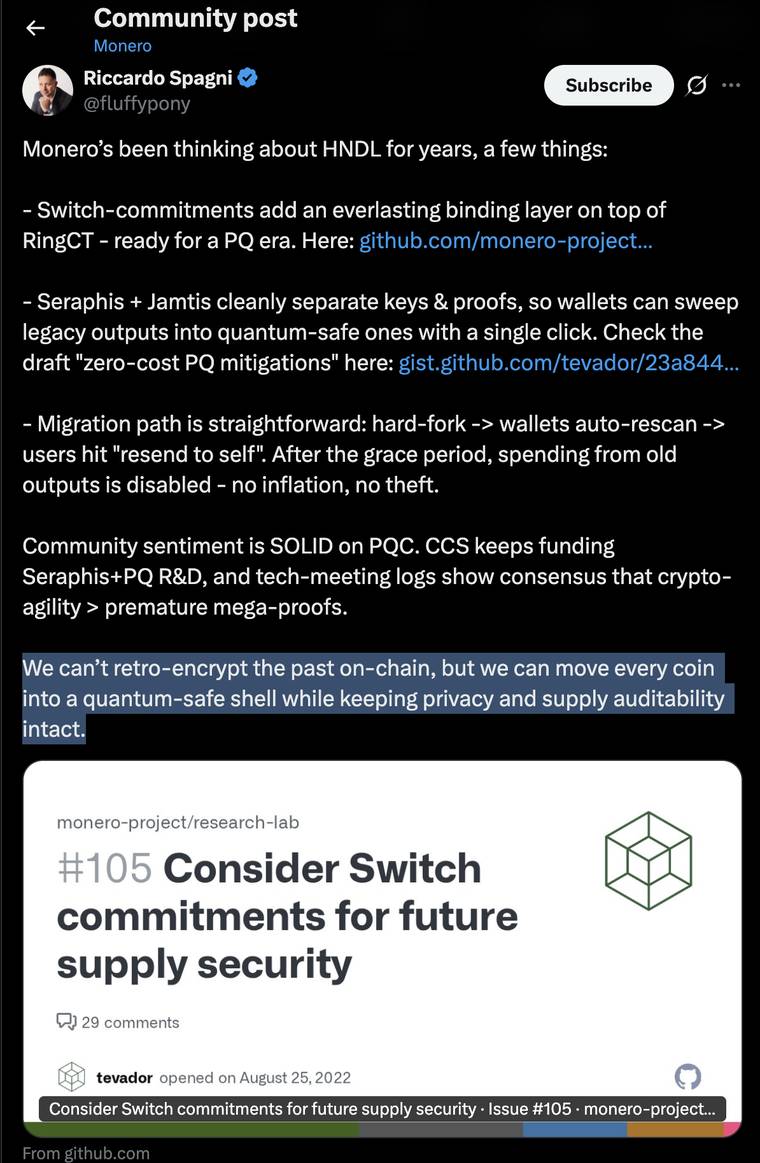
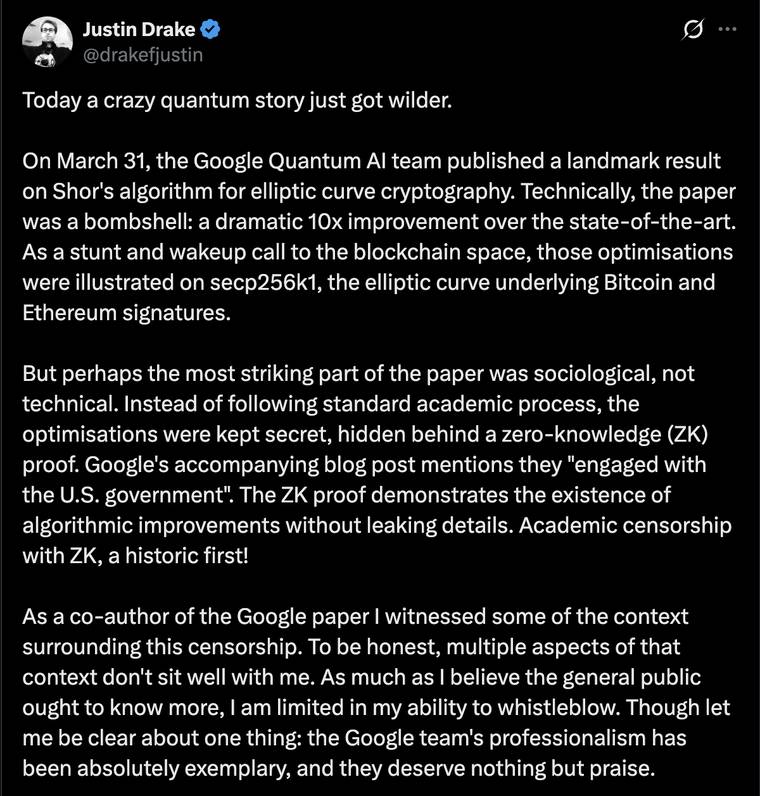
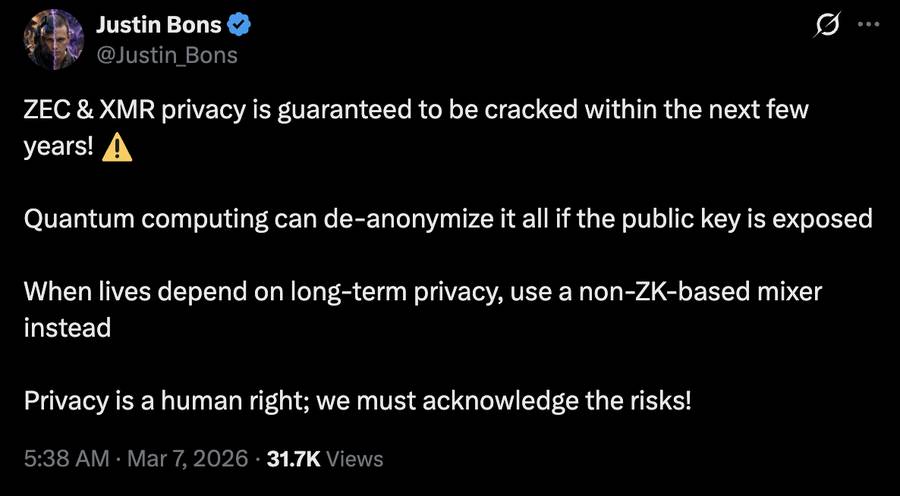
Post-quantum migrations only protect transactions made after the migration. An incumbent must rebuild its entire stack mid-flight — new PQ system, every wallet and bridge and explorer upgraded at once, every user moving funds before vulnerable pools lock, dead wallets burned, all before a Q-Day nobody can precisely predict. And even done perfectly, the recorded past stays exposed. There is no retro-encryption. The incumbents' own founders say so:
| Project | Post-quantum security | Privacy model | Status |
|---|---|---|---|
| HEGEMON | 128-bit (ML-DSA / ML-KEM) | Canonical shielded pool (MASP) | v0.10.0 · testnet live |
| Neptune | ~96-bit (Tip5 sponge) | Shielded UTXO | Testnet |
| Monero | None (ECC) | Ring signatures | Mainnet |
| Zcash | None (ECC) | Orchard (fragmented pools) | Mainnet |
| Penumbra | None (ECC) | Shielded DEX | Mainnet |
| QRL | Strong (XMSS) | None | Mainnet |
Strong PQ signatures exist without privacy; strong privacy exists without PQ security. Hegemon is built to be the first chain to ship both at the 128-bit level.
128-bit post-quantum security, end to end
Single canonical shielded pool
All transactions in one unified MASP privacy set from genesis. No transparent escape hatches, no fragmented pools, no migration debt.
Transparent STARK proofs
Plonky3 zero-knowledge proofs with hash-based security only — no trusted setup ceremony, no toxic waste, designed for the post-quantum era.
NIST-standardised lattice crypto
ML-DSA (FIPS 204) authentication and ML-KEM-1024 (FIPS 203) encryption, with SLH-DSA for long-lived trust roots.
Selective disclosure
Disclosure-on-demand payment proofs: prove a transaction to an exchange, auditor or counterparty — cryptographically, privately, when you choose. Privacy with accountable disclosure.
Ten releases and counting. v0.10.0 just shipped.
Every claim below is verifiable in the public monorepo — 1,124+ commits, MIT-licensed, multi-node testnet with public seeds.
First public alpha — node, wallet, PoW
Disclosure-on-demand payment proofs
Post-quantum libp2p transport
STARK proof batching · fork recovery
Peer discovery · commitment proofs
Desktop app · walletd · release build
AI-native development
Hegemon is built with 40–50B frontier-model tokens of AI-assisted engineering — and cryptography is the one domain where that compounds safely: protocols are strictly verifiable, so AI proposes and math disposes. Every change is gated by proofs, test suites and external audit. A fork copies the code — not the compounding machine that produces the next version.
Your rewards are shielded from block one
Block rewards are minted directly into the shielded pool — no other chain mines like this. Accumulate privately; disclose on your terms. CPU-mineable today on hardware you already own.
Full walkthrough: runbooks/miner_wallet_quickstart.md ↗
Low difficulty window
Alpha-stage network — every core you point at Hegemon earns a disproportionate share of epoch-one emission (~50% of all supply is mined in the first four years).
Fair launch, verifiably
No pre-mine, no ICO, no insider genesis. The genesis-allocation parameters in the open-source code are locked at zero. Miners compete against no one who got in for free.
Quantum researchers turned protocol engineers
Shipping post-quantum technology since 2021 — Pauli Group provides core R&D under a services agreement.

Pierre-Luc Dallaire-Demers, PhD
Engineering physics at Harvard; career quantum-computing researcher. Pierre-Luc built Anchor — the first quantum-resistant wallet on Ethereum, using Lamport signatures years before post-quantum was a headline — authored "Brace For Impact" (arXiv:2508.14011), the CRQC-timeline analysis cited across this page, launched the NUMS quantum cryptanalysis challenge, and runs the post-quantum community on X. He designed the Hegemon protocol architecture end to end.

William Doyle
Rust and full-stack blockchain engineer. Built the Hegemon node implementation, consensus engine and wallet infrastructure; core contributor to Anchor Wallet.

John Lilic
Crypto operator since 2013 — six years at ConsenSys (MetaMask), two at Polygon — who pivoted to quantum early and wrote the book on it: From Crypto Revolutions to Physics-Enforced Money. Legal structuring, fundraising, operations.
Open source. Fair launch. Built in public.
Run a node
Clone the repo and join the testnet — quickstart in the README.
Join the community
The post-quantum community on X — research, releases and discussion.